What binaural beats actually are
Binaural beats are not a treatment modality. They are an auditory phenomenon discovered in the 19th century, before modern neuroscience, and later adopted by clinicians and marketeers interested in influencing brain states through sound.
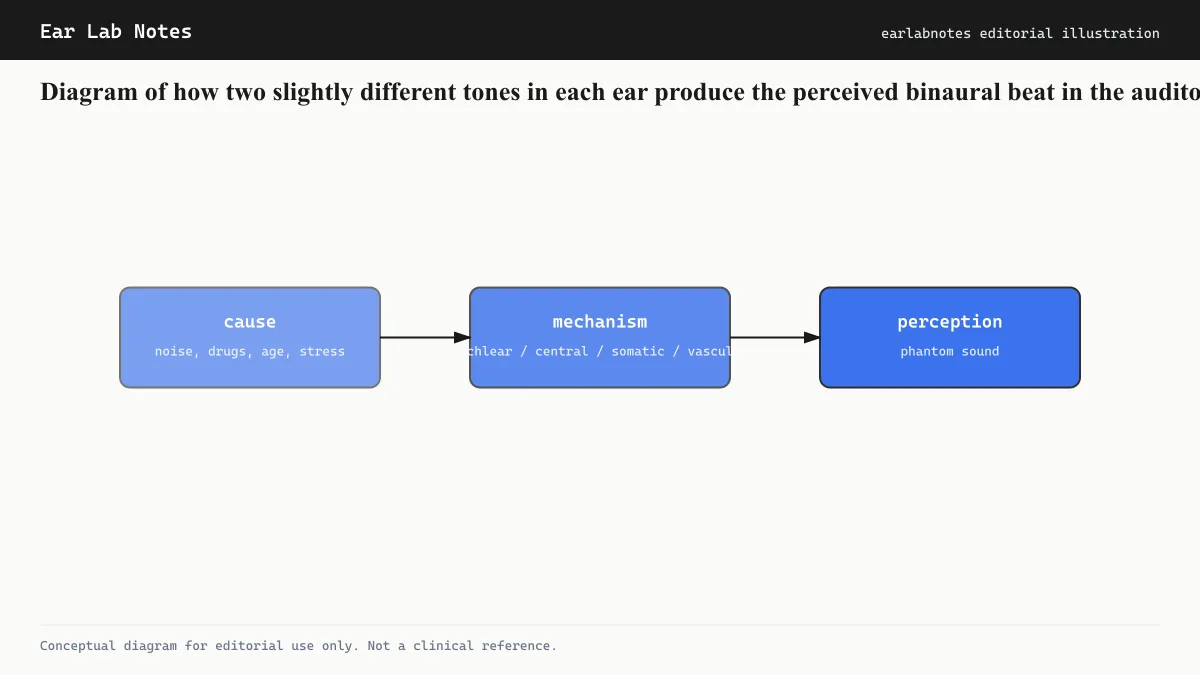
The phenomenon is straightforward. When each ear receives a pure tone of a slightly different frequency, the auditory brainstem, specifically structures involved in detecting spatial sound cues, processes the difference. The result is a perceived pulsing or oscillation at the frequency equal to the difference between the two tones. This perceived beat is generated within the nervous system, not by any physical vibration in the environment.
A 40 Hz binaural beat, for example, requires a tone of approximately 200 Hz in one ear and 240 Hz in the other. The 40 Hz oscillation is constructed internally.
Why tinnitus sufferers use them
The marketing logic behind binaural beats for tinnitus tends to follow one of two claims.
The first is relaxation. Some research has found that exposure to binaural beats in certain frequency ranges is associated with self-reported relaxation and reduced anxiety. Given that anxiety is a well-documented amplifier of tinnitus distress, a relaxation-producing intervention could theoretically reduce perceived tinnitus severity even if it has no direct effect on the phantom signal itself.
The second is frequency entrainment. Some proponents claim that binaural beats can synchronize brainwave activity to the beat frequency, and that specific frequencies, often in the theta or alpha range, are particularly beneficial for tinnitus. The evidence for brainwave entrainment from binaural beats is contested, and even if entrainment occurs, its translation to tinnitus relief requires additional mechanistic steps that have not been demonstrated clearly.
What the controlled studies show
A handful of controlled studies have examined binaural beats specifically for tinnitus. Several consistent patterns emerge from the published literature:
Study sizes are small, typically fewer than 50 participants. This limits statistical power and increases the likelihood that positive findings reflect chance.
Blinding is difficult. Participants can often tell whether they are receiving a binaural beat or a control stimulus, which introduces expectation effects.
Outcome measures vary considerably between studies, making it difficult to pool results meaningfully.
Results are mixed. Some trials report statistically significant reductions in tinnitus handicap or annoyance scores. Others report no difference from control conditions. The studies reporting benefit are not always replicated.
No large, rigorously designed trial has established binaural beats as a recommended treatment for tinnitus according to current clinical guidelines from bodies including the AAO-HNS or NIH/NIDCD.
Comparison with better-established sound therapies
For context, the sound therapies with the strongest evidence base for tinnitus are:
Masking with broadband noise, which reduces tinnitus contrast and has well-understood perceptual mechanisms.
Low-level broadband sound used in tinnitus retraining therapy, which combines sound enrichment with systematic counseling to promote habituation.
Sound enrichment generally, supported in tinnitus guidelines as a component of comprehensive management.
Binaural beats sit outside this evidence tier. That does not mean they cannot be useful for some individuals, but it means that claims of specific tinnitus-targeting mechanisms, or of superiority over simpler approaches like pink noise or nature sounds, are not supported by the current evidence base.
The specific frequency claims examined
Marketing for binaural beats often specifies particular frequency ranges: delta (1 to 4 Hz) for deep sleep, theta (4 to 8 Hz) for relaxation and creativity, alpha (8 to 14 Hz) for calm focus, beta (14 to 30 Hz) for alertness. The claim is that entraining brainwaves to these frequencies produces the associated cognitive or emotional states.
The brainwave entrainment hypothesis rests on the idea that the auditory brainstem response to the beat frequency drives cortical oscillations to synchronize with that frequency. Research has found some evidence of cortical following responses to binaural beats, but the jump from “the cortex responds to the beat” to “this response produces a clinically meaningful change in tinnitus” is large and not well supported.
For tinnitus specifically, no particular beat frequency has been established as more effective than others. The variation in protocols across published studies, which used different frequencies, durations, and sound carriers, makes the studies impossible to pool in a way that would identify an optimal frequency even if one existed.
Practical considerations if someone chooses to try them
Headphones are required. Speakers do not produce the binaural effect because sound from both speakers reaches both ears.
Volume should remain comfortable. Any sound-based intervention should be used at a level that does not contribute to further noise exposure.
The effect, if any, is likely mediated by relaxation rather than any direct action on tinnitus mechanisms. This means binaural beats would be most useful for managing the distress and anxiety component of tinnitus rather than the phantom sound itself.
They should not replace approaches with stronger evidence. CBT, audiological assessment, and sound enrichment strategies recommended by qualified professionals are the appropriate foundation for tinnitus management.
Anyone with significant or changing tinnitus should have a clinical evaluation before relying on any self-directed sound therapy, whether binaural beats or otherwise.
The relaxation argument: what it can and cannot claim
The most defensible claim for binaural beats in tinnitus is via the relaxation pathway. If binaural beats in the theta or alpha frequency range produce measurable relaxation, and if relaxation reduces anxiety, and if anxiety amplifies tinnitus distress, then binaural beats could reduce tinnitus distress through an indirect chain.
Each step in that chain has some evidence. Binaural beats have been associated with relaxation in some controlled conditions. Anxiety is a well-documented amplifier of tinnitus salience, as the British Tinnitus Association and NHS UK both note in their tinnitus guidance. The chain itself has not been studied end-to-end in a well-designed trial.
This matters because the indirect claim is much weaker than what marketing typically implies. It would also mean that any relaxation technique, progressive muscle relaxation, slow breathing, guided imagery, or mindfulness, could produce a similar or greater effect through the same pathway. The specific acoustic technology of binaural beats may not add meaningful benefit beyond the relaxation component.
How binaural beats compare with established options
NIH/NIDCD and AAO-HNS guidelines for tinnitus management do not list binaural beats among established interventions. Broadband masking sounds, low-level sound generators used in tinnitus retraining therapy, and hearing aids for concurrent hearing loss have clearer mechanistic rationale and more consistent trial evidence.
This is not a prohibition on using binaural beats. It is a calibration of expectations. People who find that they help with relaxation, which in turn makes tinnitus less intrusive, are experiencing a real benefit. That benefit is better attributed to relaxation than to any precision frequency-targeting mechanism. Understanding this distinction helps people avoid substituting binaural beats for interventions with stronger evidence, particularly when tinnitus is severe or significantly affecting daily life.
If symptoms persist or change, see an audiologist or physician.
Related notes
Frequently asked
Questions readers ask
- What are binaural beats?
- Binaural beats are an auditory illusion produced when each ear receives a tone of a slightly different frequency. If the left ear hears 200 Hz and the right ear hears 210 Hz, the brain perceives a beat pulsing at 10 Hz. The beat does not exist in the audio; it is generated within the auditory brainstem.
- Do binaural beats help tinnitus?
- The evidence is limited. A small number of controlled trials have examined binaural beats for tinnitus, with mixed results. Some studies report subjective improvements in tinnitus annoyance scores; others find no significant effect compared to control conditions. No large, well-blinded trial has established binaural beats as an evidence-based treatment for tinnitus.
- Why are binaural beats often marketed for tinnitus?
- Binaural beats have been associated with general relaxation and stress reduction in some research, and stress is a known amplifier of tinnitus distress. The marketing frequently implies a more direct mechanism than the evidence supports. Tinnitus sufferers are a natural audience for any sound-based intervention.
- Do I need headphones for binaural beats to work?
- Yes. Binaural beats require each ear to receive a separate tone. Stereo speakers in a room allow sound to mix acoustically before it reaches each ear, which prevents the binaural effect from occurring. Over-ear or in-ear headphones that deliver separate signals to each ear are necessary.
- Are there any risks from using binaural beats?
- At normal listening volumes, binaural beats are not known to be harmful. Some people report headaches or dizziness if used at high volume or for extended periods. People with epilepsy are sometimes advised to consult a doctor before use, since rhythmic auditory stimulation has theoretical interactions with seizure thresholds, though evidence for this specific risk is limited.
Primary sources
Where this comes from
- ◆Tinnitus: Assessment and Management · NIH/NIDCD
- ◆Tinnitus Clinical Practice Guideline · AAO-HNS
- ◆Tinnitus sound therapy · British Tinnitus Association
- ◆Tinnitus: Diagnosis and treatment · Mayo Clinic
Educational use only.
If your symptoms persist or change, see a licensed audiologist or otolaryngologist. Sudden hearing loss is a medical emergency, see a clinician within 72 hours.
TEL-N004 · The Ear Lab · earlabs.app