Exercise has a complex relationship with tinnitus. The type of exercise matters. Aerobic activity and high-intensity resistance training produce different physiological responses, and those differences are relevant to how tinnitus behaves during and after exercise.
Aerobic exercise and tinnitus
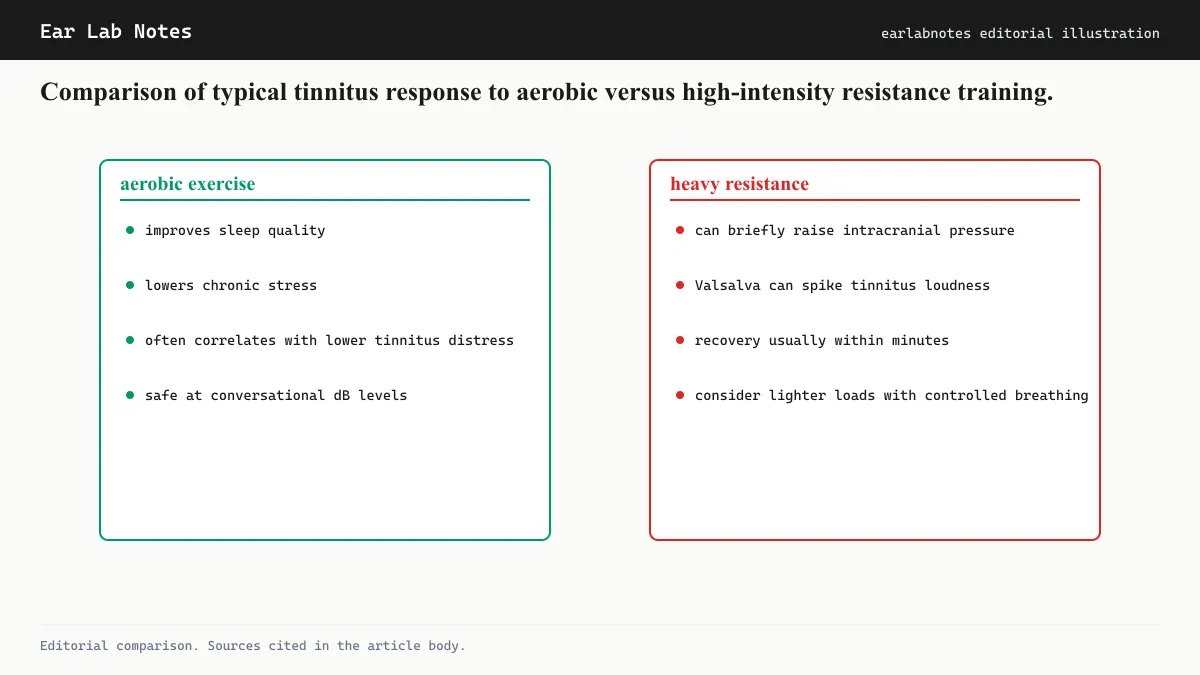
Sustained aerobic activity, including walking, running, cycling, and swimming, affects several systems that interact with tinnitus.
Cardiovascular fitness from regular aerobic exercise improves circulation, including to the cochlea. The cochlear stria vascularis, which maintains the electrochemical environment of the inner ear, depends on reliable blood supply. Good cardiovascular fitness is associated with better cochlear health, though the magnitude of this effect on tinnitus symptoms in people who already have chronic tinnitus has not been quantified in large trials.
More reliably, aerobic exercise improves sleep quality. Sleep is one of the most potent modulators of tinnitus perception, and the relationship is bidirectional: poor sleep worsens tinnitus, and tinnitus worsens sleep. Mayo Clinic’s tinnitus management guidance lists stress reduction and improved sleep among the most practical self-management steps, and aerobic exercise is among the better-studied approaches to improving both.
Exercise also reduces the background level of physiological stress and anxiety. The limbic system’s activation under stress amplifies the perceived salience of tinnitus. Regular aerobic exercise lowers baseline cortisol and improves emotional regulation over time, which is consistent with the observation that people with better physical fitness tend to report lower tinnitus distress even when the underlying phantom signal is similar.
High-intensity resistance training
Heavy resistance exercises, particularly compound lifts such as squats, deadlifts, and overhead presses, can briefly amplify tinnitus during the effort phase. The mechanism involves intracranial and intralabyrinthine pressure.
Heavy exertion with breath-holding, the Valsalva maneuver, increases pressure in the thorax, which propagates through venous return to raise intracranial pressure transiently. The fluid compartments of the inner ear are connected to cerebrospinal fluid dynamics, and this pressure change can briefly alter inner ear mechanics and increase tinnitus perception.
The effect is typically transient. Tinnitus that spikes during a heavy set generally returns to its pre-exercise baseline within minutes of stopping the activity.
For most people with tinnitus, this transient change does not represent a concern. For people with pulsatile tinnitus or tinnitus associated with vascular conditions, the pressure dynamics of heavy lifting are worth discussing with a physician before engaging in high-intensity resistance training.
Noise at the gym
Gym environments can be loud. Music systems in commercial gyms frequently run at levels that, according to NIOSH occupational noise guidance, would exceed permissible limits for extended exposure. The standard NIOSH reference is 85 dBA as the level at which protection is warranted for eight-hour occupational exposure, with the permissible time halving for each 3 dB increase.
For people with existing tinnitus, particularly noise-induced tinnitus, additional noise exposure at the gym is worth considering. Earplugs are available that attenuate broad-spectrum noise without significantly affecting the ability to perceive environmental cues, which makes them practical in the gym setting.
This is a prevention consideration rather than a treatment recommendation. Limiting additional noise exposure in any environment is a reasonable strategy for people managing noise-induced cochlear damage.
Exercise as part of a broader management approach
Exercise is not a treatment for tinnitus. It does not address the underlying cochlear damage or the central-gain changes that generate the phantom sound. What it does is improve the factors that influence how tinnitus is experienced on a day-to-day basis: sleep quality, stress levels, emotional regulation, and cardiovascular health.
The BTA lists regular moderate exercise as part of its lifestyle guidance for tinnitus, alongside other behavioral factors. The NHS similarly mentions staying active as part of general tinnitus self-management.
For most people with tinnitus, a regular aerobic exercise routine has benefits that extend well beyond tinnitus and is unlikely to worsen the condition. The main tinnitus-specific precaution is awareness of ambient noise levels in the exercise environment.
If symptoms persist or change, see an audiologist or physician.
Related notes
Frequently asked
Questions readers ask
- Is it safe to exercise with tinnitus?
- For most people, aerobic exercise is safe and may be beneficial for tinnitus management through its effects on sleep, stress, and cardiovascular health. People with pulsatile tinnitus or tinnitus associated with vascular conditions should discuss exercise with their physician before starting a new routine.
- Why does my tinnitus seem louder during heavy lifting?
- High-intensity resistance exercises, particularly those involving the Valsalva maneuver (breath-holding under load), transiently raise intracranial and intralabyrinthine pressure. This can briefly amplify tinnitus. The effect is typically short-lived.
- Can running improve tinnitus?
- Running and other sustained aerobic activities improve cardiovascular fitness, sleep quality, and stress regulation, all of which influence tinnitus perception. There is no evidence that running directly reduces the auditory signal, but the indirect effects on distress and sleep can be meaningful.
- Should I wear ear protection at the gym?
- Gym environments, particularly those with loud music, can exceed safe exposure limits according to NIOSH guidelines (85 dBA as a reference point for extended occupational exposure). People concerned about noise-induced worsening of existing tinnitus may find earplugs practical in loud gym settings.
- Does exercise affect Meniere's disease-related tinnitus differently?
- Meniere's disease involves endolymphatic pressure changes that can be affected by physical exertion and positional changes. People with Meniere's should discuss their exercise plan with the clinician managing their condition, as the response may differ from tinnitus without a hydrops component.
Primary sources
Where this comes from
- ◆Tinnitus · National Institute on Deafness and Other Communication Disorders (NIDCD)
- ◆Tinnitus: Lifestyle and Home Remedies · Mayo Clinic
- ◆Lifestyle and Tinnitus · British Tinnitus Association (BTA)
- ◆Noise-Induced Hearing Loss · National Institute for Occupational Safety and Health (NIOSH/CDC)
Educational use only.
If your symptoms persist or change, see a licensed audiologist or otolaryngologist. Sudden hearing loss is a medical emergency, see a clinician within 72 hours.
TEL-N011 · The Ear Lab · earlabs.app