The claim and the counter-evidence
A popular health claim holds that drinking more water can reduce tinnitus. The claim is appealing in its simplicity, and general hydration advice is rarely harmful, but the evidence underlying this specific claim is thin.
To understand why, it helps to look at how the inner ear actually manages its fluids, and why those fluids are not simply extensions of the bloodstream.
Two compartments, tightly controlled
The cochlea contains two fluid-filled compartments that are chemically distinct from each other and from the fluids elsewhere in the body.
Endolymph, which fills the scala media (the middle compartment of the cochlea), is unusual in biological terms because it is high in potassium and low in sodium. This is the opposite of most extracellular fluids, which are sodium-rich. Endolymph’s high-potassium composition creates the endocochlear potential, an electrical gradient that powers the transduction of sound into nerve signals.
Perilymph, which fills the other two chambers, resembles other extracellular fluid more closely but is still carefully maintained.
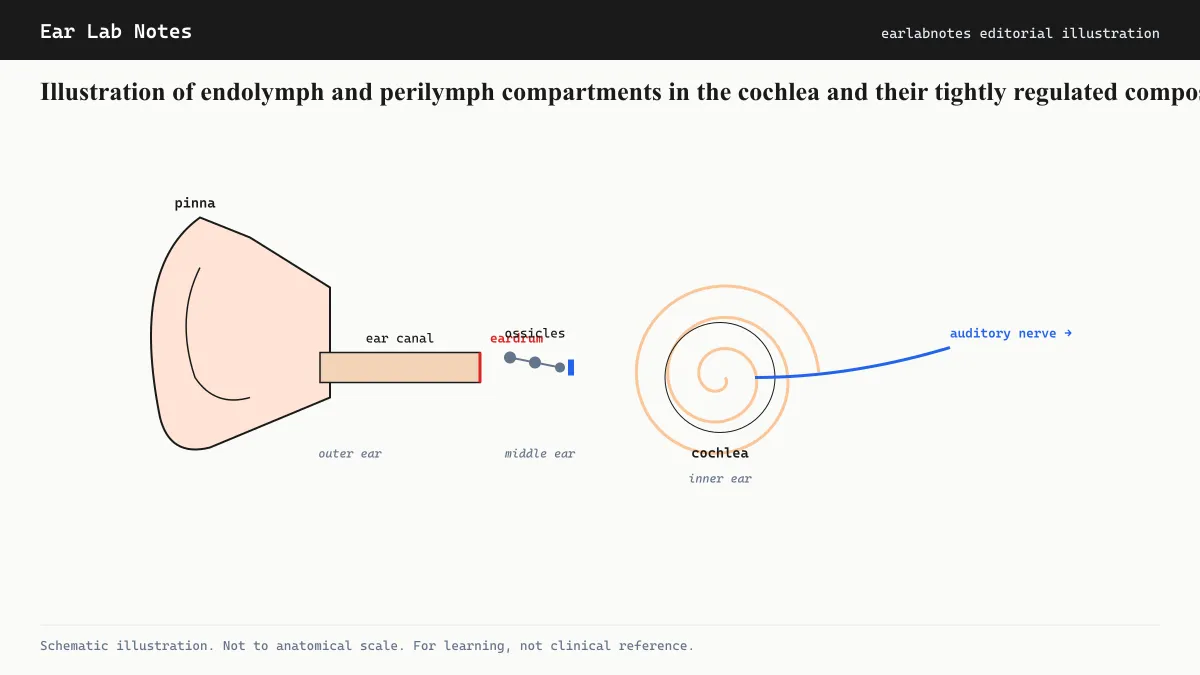
The stria vascularis, a specialized tissue lining the cochlear duct, actively pumps ions to maintain endolymph composition. This active regulation means that ordinary variation in systemic hydration does not translate directly into changes in endolymph composition. The system has buffering capacity.
According to NIDCD educational materials, the inner ear’s fluid regulation is among the most precise in the human body. The comparison to other tightly regulated systems, such as cerebrospinal fluid, is appropriate: these are not passive pools of water that respond proportionally to how much you drink.
Where the myth originates
There are two plausible origins for the dehydration-tinnitus link.
The first is Meniere’s disease. Meniere’s is characterized by endolymphatic hydrops, a condition in which the inner ear’s fluid pressure becomes elevated, disrupting the barrier between endolymph and perilymph. The classical triad of Meniere’s includes fluctuating hearing loss, episodic vertigo, and a characteristic low-pitched roaring tinnitus.
For Meniere’s, managing sodium intake and fluid balance is a component of standard treatment because these factors influence endolymphatic pressure through mechanisms that are specific to the Meniere’s physiology. Low-sodium diet and, in some cases, diuretics are recommended by clinicians. This is an evidence-grounded recommendation for Meniere’s specifically.
The problem arises when this specific connection gets generalized to all tinnitus. The vast majority of tinnitus is not caused by endolymphatic hydrops. For noise-induced tinnitus, age-related hearing loss, medication-related tinnitus, or somatic tinnitus, there is no equivalent fluid-pressure mechanism for hydration to act on.
The second origin is blood pressure changes from severe dehydration. Significant dehydration can reduce blood volume and lower blood pressure. The cochlea is supplied by a single end-artery with no collateral backup, so severe drops in blood pressure can affect cochlear perfusion. This is a plausible pathway, but it requires a level of dehydration that is genuinely severe, not the mild dehydration of a normal warm day.
The placebo context
Tinnitus has a particularly large and well-documented placebo response. In controlled clinical trials, sham interventions routinely produce meaningful subjective improvements in perceived tinnitus loudness and distress, sometimes approaching the improvements seen in active treatment arms. This context is important when evaluating anecdotes about hydration and tinnitus.
Someone who starts drinking more water may also be sleeping more, eating differently, reducing caffeine, or managing stress. Attributing improvement to water specifically is difficult even in well-intentioned self-observation.
Reasonable hydration without overclaiming
None of this means hydration is irrelevant to health. Adequate fluid intake supports blood pressure regulation, kidney function, general circulation, and many other systems. For people who are genuinely chronically under-hydrated, improving fluid intake is sensible. There is no specific evidence that it will reduce tinnitus for most people, but it is unlikely to cause harm.
Mayo Clinic and NHS UK materials on tinnitus management list lifestyle factors including adequate sleep, stress management, and sound enrichment as the behavioral pillars of conservative care. Hydration beyond adequate levels is not listed as an evidence-based intervention for tinnitus.
The specific case that is real: Meniere’s
If you have been diagnosed with Meniere’s disease by a physician, then the conversation about fluid and sodium management is clinically grounded and different from the general tinnitus population. The mechanism is specific, the evidence for dietary sodium reduction in Meniere’s is more established, and the clinical management approach is distinct.
For everyone else, the simple, honest summary is that ordinary hydration is unlikely to change tinnitus. The inner ear has its own regulated fluid system, and drinking more water does not directly access it.
If symptoms persist or change, see an audiologist or physician.
Related notes
Frequently asked
Questions readers ask
- Can dehydration cause tinnitus?
- Ordinary mild dehydration, such as a hot afternoon without enough water, is unlikely to produce or significantly worsen tinnitus. The inner ear fluids are among the most tightly regulated in the body and are buffered against routine fluctuations in systemic hydration.
- Why do some people say drinking more water helped their tinnitus?
- Anecdotal reports are common, and the placebo effect in tinnitus research is well documented. Additionally, severe dehydration that causes blood pressure changes could theoretically affect cochlear perfusion. But for most people, moderate hydration changes are unlikely to produce measurable tinnitus changes.
- Is there a real connection between fluid and tinnitus?
- Yes, but it is specific to Meniere's disease, where endolymphatic hydrops (excess fluid pressure in the inner ear) is the structural problem. In that narrow context, managing fluid intake and sodium are part of clinical management. That connection does not generalize to tinnitus from other causes.
- Should people with tinnitus drink more water?
- General adequate hydration is sensible for overall health. There is no specific evidence that increasing water intake above normal levels reduces tinnitus in people without Meniere's disease. A physician or audiologist is the right source for advice on managing tinnitus.
Primary sources
Where this comes from
- ◆Tinnitus: Overview and Management · NIH/NIDCD
- ◆Meniere's Disease · NIH/NIDCD
- ◆Meniere's Disease: Symptoms and Causes · Mayo Clinic
- ◆Tinnitus · NHS UK
Educational use only.
If your symptoms persist or change, see a licensed audiologist or otolaryngologist. Sudden hearing loss is a medical emergency, see a clinician within 72 hours.
TEL-N017 · The Ear Lab · earlabs.app