Noise-induced tinnitus develops when sound pressure levels damage the sensory hair cells inside the cochlea. It is among the most preventable forms of tinnitus, yet also one of the most common. NIDCD estimates that approximately 17 percent of people aged 20 to 69 in the United States have some degree of noise-induced hearing damage, and ringing in the ears is often the first perceptible sign.
Understanding exactly what different decibel levels do to the inner ear helps explain why this condition is so widespread and why early warning signs are so easy to dismiss.
The decibel scale and why each step matters more than you think
The decibel (dB) scale is logarithmic, not linear. A sound at 90 dB carries about 10 times the acoustic energy of a sound at 80 dB, and about 100 times that of a sound at 70 dB. This compresses a vast range of intensities into a manageable scale but makes everyday comparisons counterintuitive.
Common reference points:
- Quiet library: approximately 30 dB
- Normal conversation: approximately 60 dB
- Lawn mower: approximately 90 dB
- Live music venue: typically 100 to 115 dB at typical audience positions
- Jet engine at 100 feet: approximately 130 dB
The threshold of concern for hearing damage begins at 85 dB. Below this level, even prolonged daily exposure is unlikely to cause measurable permanent damage for most people.
NIOSH permissible exposure limits
NIOSH has published recommended exposure limits based on the relationship between sound level and cochlear injury. These limits follow a 3-dB exchange rate, meaning that for every 3-dB increase in sound level, the recommended maximum exposure time is halved.
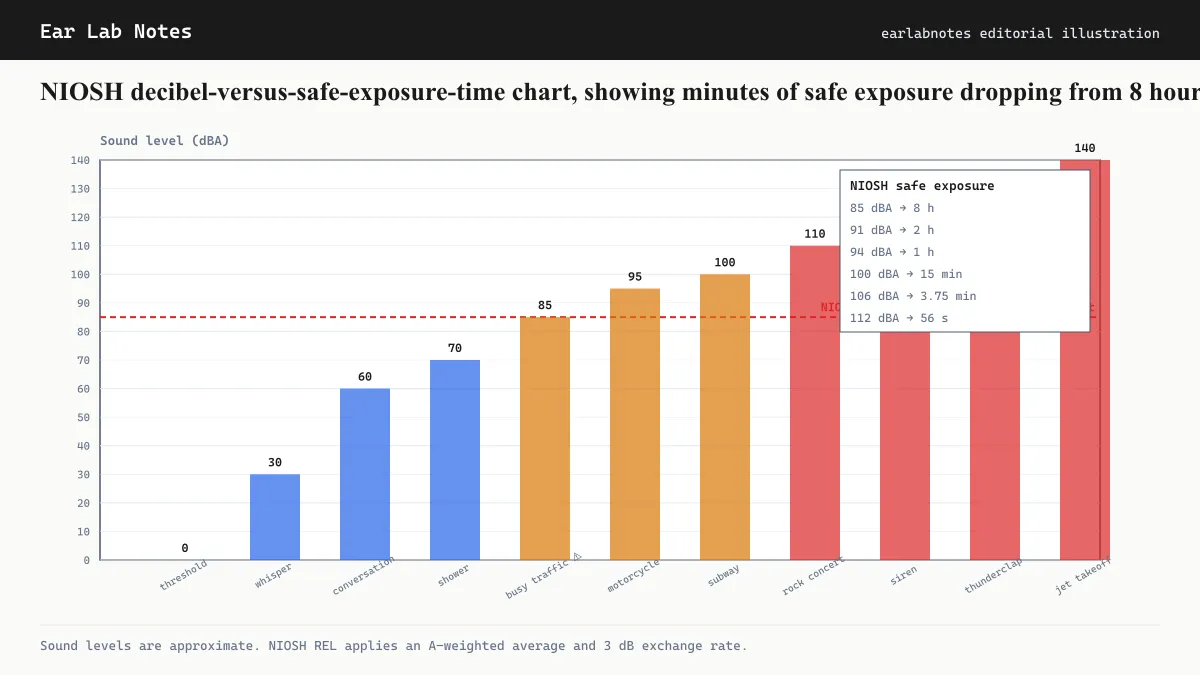
Key limits from the NIOSH standard:
- 85 dB: 8 hours
- 88 dB: 4 hours
- 91 dB: 2 hours
- 94 dB: 1 hour
- 97 dB: 30 minutes
- 100 dB: 15 minutes
- 110 dB: approximately 1 minute
- 115 dB: less than 30 seconds
OSHA uses a 5-dB exchange rate and permits somewhat longer exposure at higher levels, but NIOSH notes that the 5-dB rate may underestimate cochlear risk. Many occupational audiologists apply the more conservative NIOSH standard when advising workers.
What 85 dB does to hair cells over time
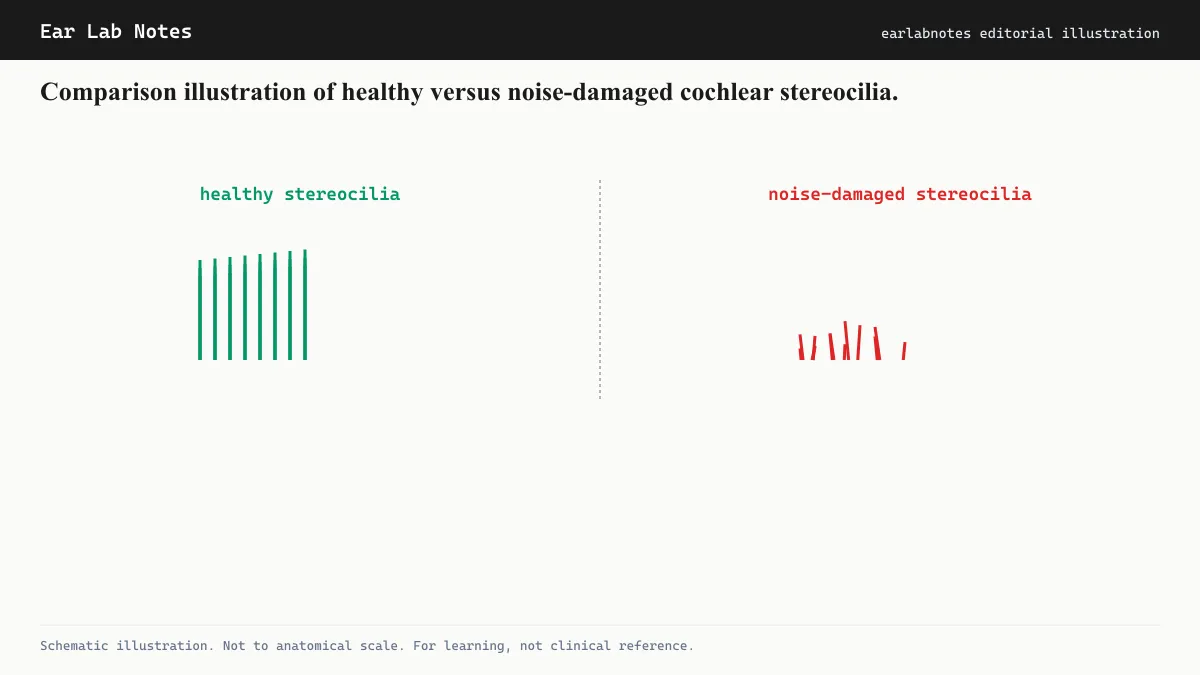
At 85 dB, mechanical energy from sound waves displaces the basilar membrane inside the cochlea with enough force to bend the stereocilia (tiny hair-like projections) on cochlear hair cells. Under sustained load, the stereocilia experience metabolic stress. The outer hair cells, which amplify the traveling wave before inner hair cells detect it, are the first to suffer.
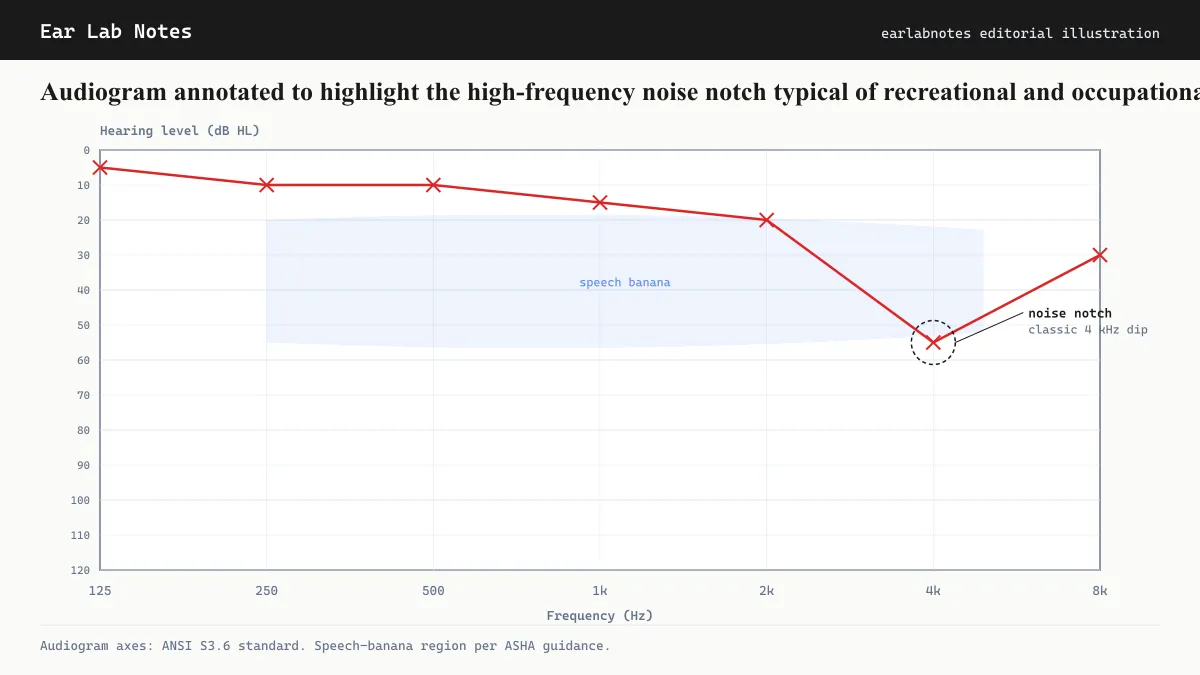
At this level, damage is unlikely during a single 8-hour session, but years of daily occupational exposure without hearing protection can produce a gradual, cumulative loss. The process is painless and slow enough that many people do not notice it until a standard audiogram reveals hearing loss at 4 kHz.
What 95 dB does in a short session
At 95 dB, the NIOSH limit is approximately 1 hour. This is a sound level typical of a power saw, a motorcycle, or a nightclub measured at a position close to a speaker stack.
At this level, a person may experience a temporary threshold shift: hearing becomes less sensitive for several hours after exposure, and a temporary ringing or muffled quality appears. This is the auditory system signaling that the hair cells are under stress. In most cases, recovery happens within 16 to 48 hours.
The key word is “temporary.” Hair cells recover from transient mechanical stress if given adequate rest. The problem is that repeated temporary shifts, without recovery time between exposures, cumulatively tip cells toward permanent damage.
What 110 dB does almost immediately
At 110 dB, NIOSH permits exposure of under a minute before damage risk becomes significant. This is the level near the front row of many live concerts, next to a running gas-powered chainsaw, or inside a club with aggressive sound reinforcement.
At this intensity, stereocilia can be physically disrupted rather than merely stressed. The lateral links holding the stereocilia bundle together can rupture. Tip links, which gate the mechanotransduction channels that convert movement into electrical signal, can detach. Neither type of damage repairs quickly, and loss of tip links is particularly associated with the onset of tinnitus.
Why ringing often appears before detectable hearing loss
Standard audiometry measures the quietest tones a person can detect at each frequency. This threshold is set by the inner hair cells, which are more resilient than the outer hair cells. Outer hair cells can sustain significant damage before inner hair cell thresholds shift noticeably.
Because tinnitus is strongly associated with outer hair cell damage and the subsequent loss of amplification that outer hair cells provide, ringing can emerge while the audiogram still looks normal or near-normal. This means that using hearing test results as the sole indicator of whether it is safe to continue noise exposure without protection is inadequate. Tinnitus after noise exposure is its own warning signal.
The noise notch
When audiologists assess people with noise-induced hearing loss, they frequently find a characteristic pattern: thresholds are near normal at low frequencies, dip significantly at 4 kHz, and then partially recover at higher frequencies. This is called the noise notch.
The 4 kHz region is particularly vulnerable because of how the cochlea’s resonance characteristics concentrate sound energy at that point. The noise notch is diagnostic for noise-induced cochlear damage and is associated with high-frequency tinnitus pitches, which is why noise-induced tinnitus often presents as a high-pitched ringing or whining.
Prevention is the only reliable intervention
Because cochlear hair cells in humans cannot regenerate, NIOSH, NIDCD, and NHS UK all emphasize prevention as the primary tool for noise-induced tinnitus. Key measures include:
Using hearing protection (earplugs or earmuffs) when working in environments above 85 dB, limiting listening device volume, taking acoustic breaks during sustained loud-environment exposure, and following noise dosimetry recommendations in industrial settings.
There is no approved pharmacological agent that reverses cochlear hair cell loss, despite active research into drug and gene therapy approaches.
What to do if tinnitus appears after noise exposure
If ringing appears after a loud event and does not resolve within 48 hours, or if the ringing is accompanied by muffled hearing that does not clear, evaluation by an audiologist or otolaryngologist is warranted. An audiogram can establish a baseline and identify whether threshold shifts have occurred. Management options exist for persistent noise-induced tinnitus and can substantially reduce its impact on daily life.
If symptoms persist or change, see an audiologist or physician.
Related notes
Frequently asked
Questions readers ask
- Will the ringing after a concert go away?
- Temporary ringing after a loud event, called temporary threshold shift, typically resolves within hours to a couple of days as hair cells recover from the mechanical stress. Repeated temporary exposures, however, can accumulate into permanent damage over time. If ringing persists beyond 48 hours, consulting an audiologist is advisable.
- Are earbuds as dangerous as power tools?
- The risk depends entirely on the volume, not the device. Earbuds playing music at maximum volume on many consumer devices can exceed 100 dB, which NIOSH classifies as safe for under 15 minutes per day. The device matters less than the decibel level reaching your ear.
- Can I reverse noise-induced tinnitus?
- Cochlear hair cells in humans do not regenerate. Ringing that persists beyond the temporary-threshold-shift window reflects damage that current clinical tools cannot reverse. Research into hair-cell regeneration is ongoing, but no approved restorative treatment exists as of 2026. Management approaches can reduce distress substantially.
- What hearing protection should I use around loud machinery?
- NIOSH and OSHA recommend using hearing protection rated for the noise level you face. Both earplugs and earmuffs reduce exposure; pairing them provides additional protection at very high levels. An audiologist or occupational health specialist can advise on the right noise reduction rating for a specific environment.
Primary sources
Where this comes from
- ◆Noise and Hearing Loss Prevention - NIOSH/CDC · National Institute for Occupational Safety and Health
- ◆Noise-Induced Hearing Loss - NIDCD · National Institute on Deafness and Other Communication Disorders
- ◆Tinnitus - Mayo Clinic · Mayo Clinic
- ◆Tinnitus - NHS · NHS UK
Educational use only.
If your symptoms persist or change, see a licensed audiologist or otolaryngologist. Sudden hearing loss is a medical emergency, see a clinician within 72 hours.
TEL-N024 · The Ear Lab · earlabs.app