Notched music therapy is one of the more precisely targeted approaches in the tinnitus sound therapy landscape. Unlike broadband noise masking, which works by raising the general acoustic background, notched music attempts to interact with specific neural mechanisms in the auditory cortex. The theory is specific, the evidence is real but limited, and the approach has attracted both genuine scientific interest and commercial interest that sometimes outpaces the data.
The underlying theory: lateral inhibition
To understand why notching might matter, it helps to know what the auditory cortex does with tinnitus.
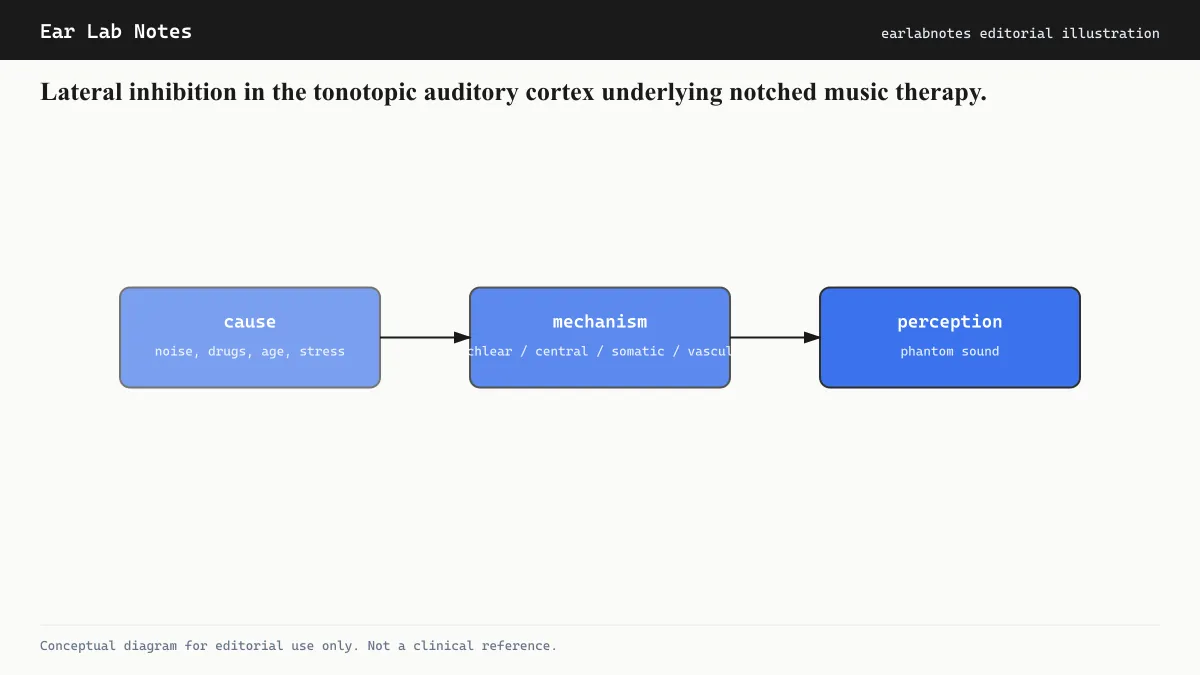
The auditory cortex is organized tonotopically. Different neurons respond to different frequencies, arranged in an orderly map across the cortical surface. When the cochlea is damaged at a particular frequency, the neurons in the corresponding cortical region receive less input than usual. The brain responds by turning up its gain at those neurons, a process called central gain increase.
This elevated neural activity in a frequency-specific region of the auditory cortex is thought to contribute to the phantom sound of tinnitus. The overactive neurons fire without corresponding external input.
Lateral inhibition is a well-established process in the auditory system. Neurons tuned to one frequency inhibit their neighbors. The theory behind notched music therapy proposes that if the frequencies immediately adjacent to the tinnitus pitch are actively stimulated by sound, they will inhibit the overactive neurons at the tinnitus frequency through lateral inhibition, potentially reducing the cortical overactivation.
What notching involves in practice
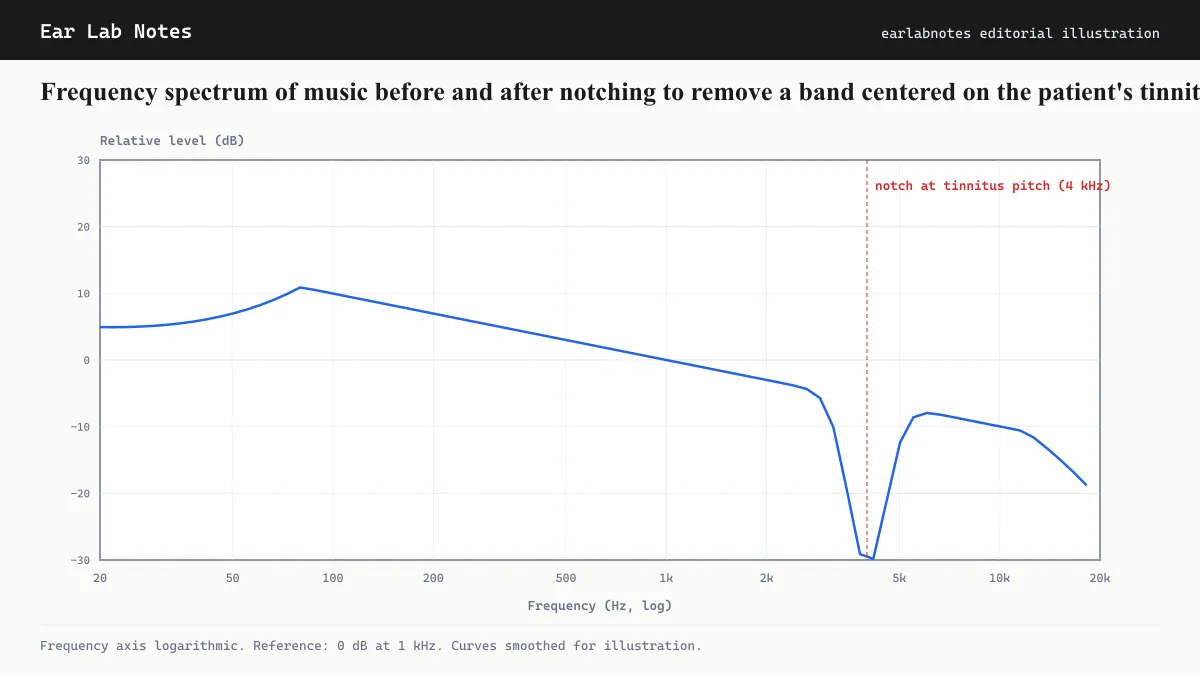
Notching is an audio processing step applied to music. A digital filter removes a band of frequencies, typically centered on the patient’s identified tinnitus pitch and spanning approximately one octave (about half an octave above and below the target pitch). The rest of the music is unchanged.
The processed music sounds slightly different because a narrow slice of its frequency content is missing, but most listeners find notched music nearly indistinguishable from unnotched music, which is one of its practical advantages. People listen while doing other activities, which distinguishes it from some more demanding intervention approaches.
The tinnitus pitch assessment problem
For notching to be targeted correctly, the tinnitus pitch must be accurately identified. Audiologists can perform pitch-matching assessments in which the patient compares the tinnitus to a series of tones and identifies the closest match.
Self-assessed pitch is less reliable. Several studies have found that patients consistently misidentify their tinnitus pitch when tested without reference tones, which means notched music created from inaccurate self-report may not be centered on the correct frequency. This is a practical limitation of consumer-facing notched music services that rely on self-report.
What the trials show
A meaningful body of research has examined notched music therapy. The results are mixed in ways that reflect the typical challenges of this research area.
Several controlled trials have reported reductions in tinnitus loudness (measured by pitch-matching) and reductions in tinnitus-related distress after weeks to months of daily notched music listening. These results, when positive, tend to be modest in size. Other studies have found smaller or less consistent effects.
The BTA, which reviews evidence across a range of sound therapies, describes notched music as a promising approach with a growing evidence base while noting that the overall evidence remains insufficient to recommend it as a standard first-line treatment. The AAO-HNS clinical practice guideline does not single out notched music therapy as a guideline-strength recommendation, though it falls within the broader category of sound therapy options that clinicians may discuss.
The quality and blinding of trials varies. Creating a convincing placebo for notched music is difficult because participants often learn whether their music is notched or not, and expectation effects are substantial in tinnitus research.
Comparison with other sound therapies
Notched music is conceptually different from broadband masking (white or pink noise). Masking works by raising the background floor to reduce contrast; it has no proposed mechanism for reducing cortical overactivation. Notched music therapy, if the theory holds, is attempting to produce a lasting change in auditory cortex organization through specific stimulation patterns.
Whether that cortical change actually occurs in humans, and whether it is clinically meaningful when it does, is what the research is still working to establish.
Broadband masking has a larger evidence base for immediate symptom relief. Notched music therapy has a theoretically more mechanistic rationale for lasting change, but the evidence for lasting change in humans is not yet conclusive.
Practical points for readers
Notched music therapy requires daily listening sessions, typically one to two hours, sustained over weeks to months. This time commitment is similar to other structured sound therapy approaches.
Any meaningful implementation begins with accurate pitch assessment. An audiologist is better positioned to do this than a self-report questionnaire.
Commercial platforms that offer notched music services vary considerably in the quality of their pitch assessment and the transparency of their evidence claims. Reading the evidence summaries that credible academic tinnitus organizations such as NIDCD and the BTA have published is a useful reference point for evaluating those claims.
If symptoms persist or change, see an audiologist or physician.
Related notes
Frequently asked
Questions readers ask
- What does 'notched' mean in notched music therapy?
- Notching refers to removing a specific narrow band of frequencies from a piece of music using audio filtering. In notched music therapy for tinnitus, the removed band is centered on the patient's tinnitus pitch, typically spanning about one octave.
- Do I need to see a clinician to access notched music?
- Some research programs and commercial services create notched music from uploaded recordings after a tinnitus pitch assessment. A formal assessment of tinnitus pitch by an audiologist is more accurate than self-reporting, and inaccurate notching may reduce or eliminate any potential effect.
- Does notched music work for all types of tinnitus?
- The research has primarily focused on tonal (pure tone or narrow-band) tinnitus at a specific pitch. People with broadband noise-like tinnitus, complex tinnitus, or tinnitus that changes pitch frequently have been studied less extensively. The mechanism requires a stable, identifiable pitch for the notching to be targeted.
- How long would I need to listen before seeing any effect?
- Published trials have used listening durations of one to two hours per day over periods of weeks to months. Shorter exposures have not been well studied. Individual responses in published trials varied considerably.
- Is notched music better than other sound therapies?
- Head-to-head comparisons with other sound therapies are limited. The evidence base for notched music therapy is smaller than for CBT or hearing aids in the presence of hearing loss. It remains an area of active research rather than a first-line recommendation.
Primary sources
Where this comes from
- ◆Tinnitus · National Institute on Deafness and Other Communication Disorders (NIDCD)
- ◆Clinical Practice Guideline: Tinnitus · American Academy of Otolaryngology-Head and Neck Surgery (AAO-HNS)
- ◆Sound Therapy for Tinnitus · British Tinnitus Association (BTA)
- ◆Tinnitus: Diagnosis and Treatment · Mayo Clinic
Educational use only.
If your symptoms persist or change, see a licensed audiologist or otolaryngologist. Sudden hearing loss is a medical emergency, see a clinician within 72 hours.
TEL-N025 · The Ear Lab · earlabs.app