What the meta-analyses show
Several large-scale reviews of the scientific literature have found a consistent positive association between cigarette smoking and hearing loss. A dose-response relationship appears across these analyses: people who smoke more cigarettes per day or who have smoked for more years tend to show greater degrees of hearing impairment compared to non-smokers.
This kind of dose-response pattern is an important marker in epidemiology. When a risk factor scales with the amount of exposure, it strengthens the case that the relationship is not just coincidence or confounding.
NIDCD research programs on hearing health have identified smoking as a modifiable risk factor for hearing loss alongside noise exposure, certain medications, and cardiovascular conditions.
The cochlear blood supply: the vascular pathway
The inner ear is extremely sensitive to changes in blood flow. The cochlea, specifically its stria vascularis, the ribbon of tissue that maintains the electrochemical environment hair cells need to function, is supplied by a single end-artery. Unlike most tissues, the cochlea has no collateral blood supply. If the main vessel is compromised, there is no backup route.
Tobacco smoke contains nicotine and carbon monoxide, among many other compounds. Nicotine causes vasoconstriction, narrowing blood vessels and reducing blood flow. Carbon monoxide competes with oxygen on hemoglobin, reducing the oxygen delivered to tissues. Both effects can reduce oxygen delivery to the cochlea.
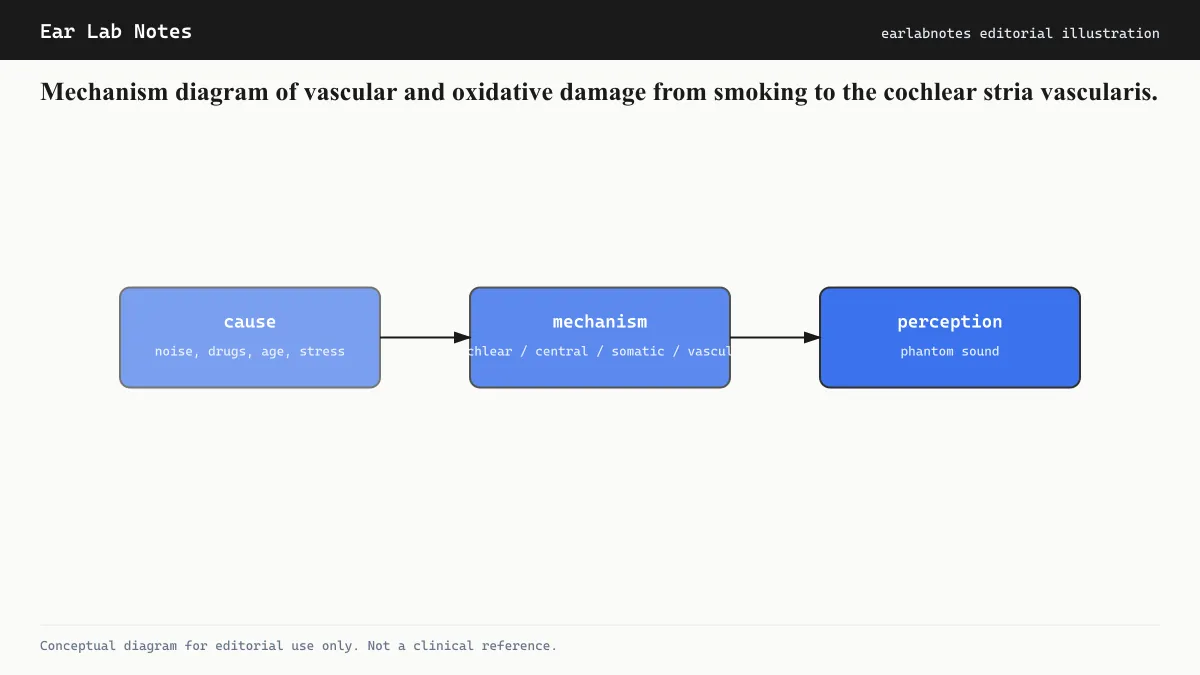
Chronic reduction in cochlear blood supply is thought to degrade the stria vascularis over time, impair the endocochlear potential, and reduce the metabolic support available to outer hair cells. Outer hair cells are the first to suffer from metabolic stress, and their loss is the primary driver of sensorineural hearing loss.
The oxidative pathway
Tobacco smoke is a rich source of reactive oxygen species (free radicals). The inner ear lacks some of the antioxidant defenses found in other tissues, which makes it comparatively vulnerable to oxidative damage. Noise-induced hearing loss is also partially an oxidative injury, which has led researchers to ask whether smoking and noise exposure might compound each other’s effects.
Some research suggests that smokers may have heightened vulnerability to noise-induced hearing loss compared to non-smokers exposed to the same noise levels. NIOSH, which sets occupational noise exposure limits, acknowledges in its broader hearing conservation guidance that individual susceptibility to noise damage varies, and smoking is among the factors that may affect that susceptibility.
Hearing loss as the tinnitus connection
The relevance to tinnitus is direct. Sensorineural hearing loss, the kind associated with cochlear damage, is the most common finding in people with tinnitus. When the cochlea sends reduced or distorted signals to the auditory cortex, the central auditory pathway compensates by increasing its gain. That increased gain amplifies internal noise into perceptible ringing, a process described as the central-gain hypothesis and reviewed by NIDCD-affiliated researchers.
Smoking does not produce tinnitus through a pathway separate from hearing loss. Rather, smoking’s effect on hearing loss is the mechanism through which it elevates tinnitus risk. This means that the implications of the smoking-hearing-loss link extend naturally to tinnitus risk.
What about passive smoke exposure?
Research on secondhand smoke and hearing loss is sparser than research on active smoking, but some studies have found elevated rates of hearing difficulty in children and adults with chronic passive exposure. The mechanisms would be similar: vascular and oxidative effects on the inner ear, but at a lower intensity and over longer time frames.
Nicotine replacement and hearing
Nicotine replacement therapies, such as patches and gum, deliver nicotine without the combustion byproducts. This eliminates the carbon monoxide and many of the oxidants in tobacco smoke. Whether nicotine itself, separate from combustion, contributes independently to hearing risk is an active area of research. Current evidence is insufficient to draw firm conclusions about nicotine replacement’s hearing-health profile.
Situating smoking in the broader risk picture
NIDCD identifies three main categories of modifiable hearing loss risk: excessive noise exposure, certain medications, and certain health conditions. Smoking straddles both the vascular-disease category and the direct toxicant category. Cardiovascular disease, which smoking also promotes, is independently associated with hearing loss through reduced cochlear perfusion.
Managing multiple risk factors is likely additive in its benefit, even if the contribution of any single change, such as stopping smoking, is difficult to isolate in a real population.
If symptoms persist or change, see an audiologist or physician.
Related notes
Frequently asked
Questions readers ask
- Does smoking cause tinnitus?
- Smoking is associated with hearing loss, and hearing loss is one of the most common causes of tinnitus. While researchers have not established a direct causal chain from smoking to tinnitus independent of its hearing-loss effect, the two associations together suggest that smoking is a meaningful tinnitus risk factor.
- How many cigarettes per day are enough to affect hearing?
- Meta-analyses have found that the association between smoking and hearing loss follows a dose-response pattern, meaning more exposure correlates with greater risk. Current research does not establish a safe minimum, and some studies include social smokers in groups that show elevated risk compared to non-smokers.
- Does quitting smoking reverse hearing damage?
- Some research suggests that former smokers have intermediate risk between current smokers and never-smokers, which hints at partial reversibility of risk. Whether established hearing loss from smoking recovers after quitting is less clear, and the answer likely depends on the degree of damage already done.
- What about vaping and hearing?
- The research on vaping and hearing is much earlier-stage than the research on cigarette smoking. Nicotine, which is present in most vaping products, is known to cause vascular constriction, which is one of the proposed mechanisms for smoking-related hearing damage. Long-term data are not yet available.
Primary sources
Where this comes from
- ◆Hearing Loss · NIH/NIDCD
- ◆Noise and Hearing Loss Prevention · NIOSH/CDC
- ◆Hearing Loss: Causes and Risk Factors · Mayo Clinic
- ◆Hearing Loss (Noise-induced and Age-related) · NHS UK
Educational use only.
If your symptoms persist or change, see a licensed audiologist or otolaryngologist. Sudden hearing loss is a medical emergency, see a clinician within 72 hours.
TEL-N032 · The Ear Lab · earlabs.app