Why attention is a limited resource
Attention is not unlimited. Cognitive research consistently shows that the human brain can only actively process a small number of information streams simultaneously. When multiple signals compete for that limited capacity, processing quality degrades across all of them.
Tinnitus adds a persistent, internally generated signal to the attentional field. For most people, the brain eventually learns to treat tinnitus as background noise and allocates less attention to it over time. For some, particularly those in the early stages of tinnitus or with high tinnitus distress, the phantom sound remains a foreground competitor for attention that would otherwise go to work, conversation, or reading.
What the research finds
Working memory
Working memory is the short-term system that holds and manipulates information during a task. It is what allows you to hold a phone number in mind while you walk to write it down, or to track the beginning of a sentence while you process its end.
Studies comparing people with chronic tinnitus to matched controls have found measurable differences in working-memory performance on tasks that require resisting distraction. The pattern is consistent with a partial occupation of working memory by the tinnitus signal, reducing the capacity available for the intended task.
The magnitude of the effect varies between individuals and across studies, and it does not reflect any structural brain change. It appears to be a functional consequence of attention load.
Selective attention
Selective attention is the ability to focus on one auditory or visual stream while filtering out others. It is central to conversation in noisy environments, to following a lecture, and to sustained reading.
People with chronic tinnitus who also have significant hearing loss face a compounded challenge here: tinnitus competes internally while the hearing loss reduces the clarity of the external signal they are trying to follow. Even without hearing loss, the internal phantom sound draws on the same selective-attention circuits.
The role of sleep and mood
Concentration difficulties in tinnitus are rarely caused by tinnitus alone. Sleep disruption is a major contributor to sustained attention deficits, and tinnitus is one of the most commonly reported causes of sleep disruption. Mood also affects concentration; the co-occurrence of depressive or anxious symptoms with tinnitus adds another layer of cognitive load.
Untangling the specific contribution of tinnitus to concentration difficulties in any individual requires considering all of these factors.
The involuntary attention problem
One feature of tinnitus-related concentration difficulty that distinguishes it from ordinary distraction is involuntary attention capture.
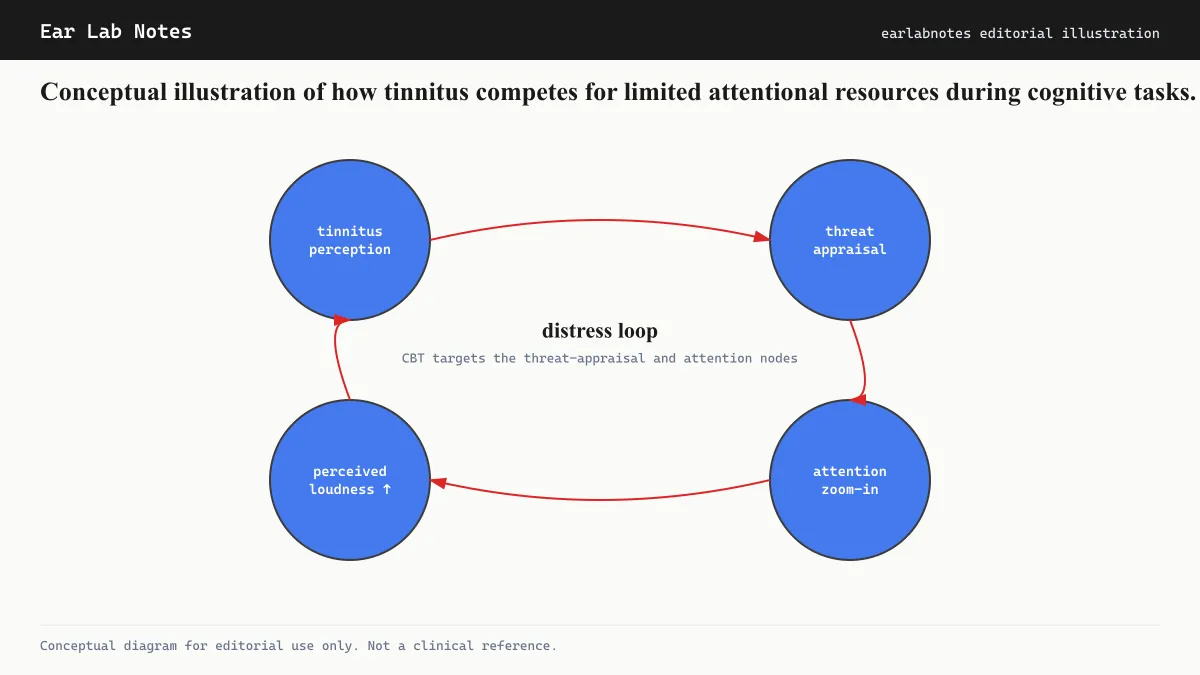
Cognitive science distinguishes between voluntary attention, which you can direct deliberately, and involuntary attention, which is triggered by salient or emotionally relevant stimuli. Tinnitus, particularly when it carries threat or distress associations, tends to capture attention involuntarily. This means that even when a person actively tries to focus elsewhere, tinnitus can pull attention back repeatedly, without conscious intent.
This mechanism is closely related to why anxiety and tinnitus interact. Anxious monitoring of potential threats is itself a form of involuntary attention allocation.
What cognitive psychology recommends
Several strategies have a reasonable evidence base or strong theoretical grounding for concentration difficulties related to tinnitus:
Sound enrichment
Providing a low-level background sound, nature sounds, fan noise, or broadband noise, reduces the contrast between silence and tinnitus. This makes the phantom sound less salient and reduces its ability to capture involuntary attention. Many people find that they can concentrate more effectively with a modest acoustic background than in silence.
Task structuring
Breaking work into shorter intervals with defined rest periods reduces the total attentional demand of any single block. This is not specific to tinnitus but is useful when any persistent distraction is present.
Addressing the distress component
CBT for tinnitus directly targets involuntary attention to tinnitus by changing the threat appraisal that makes it attention-worthy. Several controlled trials have found improvements in tinnitus handicap scores after CBT, and many participants report subjective improvements in concentration as part of those gains.
Sleep management
Given the contribution of sleep disruption to attention deficits, interventions that improve sleep quality, including CBT for insomnia and sound enrichment at night, may indirectly improve daytime concentration as much as daytime strategies.
The workplace dimension
Concentration difficulties from tinnitus are particularly significant in occupational settings where sustained attention, verbal communication, or working memory are central to the job. Open-plan offices, phone-based work, and roles requiring detailed reading or data entry are all environments where tinnitus can create meaningful functional impairment.
Some people find that noise-cancelling headphones, paradoxically, worsen concentration difficulties by increasing the relative prominence of tinnitus in the resulting quiet. Others find them useful for blocking unpredictable environmental sounds while listening to a consistent masking track.
Workplace accommodations for tinnitus are increasingly recognized in occupational health guidance. These can include a quieter working location, permission to use low-level masking sound, or flexible scheduling to manage fatigue from disturbed sleep. A GP or occupational health physician can document functional needs if workplace support is being sought.
The connection to hearing loss
Approximately half of people who seek clinical care for tinnitus have some degree of accompanying hearing loss, according to data cited by NIH/NIDCD. Hearing loss adds a second layer to concentration difficulties, because the effort of following speech in imperfect acoustic conditions, known as listening effort, consumes cognitive resources that would otherwise be available for memory and comprehension.
In people with both tinnitus and hearing loss, hearing aids that address the loss often produce marked improvements in reported concentration, partly by reducing listening effort and partly through the natural acoustic enrichment that amplification provides. This interaction is one reason audiologists routinely assess hearing as part of tinnitus evaluation.
Realistic expectations
The concentration difficulties associated with tinnitus are, for most people, not fixed or permanent. They tend to be most severe in the early months, when tinnitus is novel and threatening, and improve as habituation progresses or distress is treated.
The British Tinnitus Association and NHS UK both note that the functional impact of tinnitus, including on work and concentration, is a legitimate reason to seek clinical support. An audiologist or clinical psychologist with tinnitus experience can help develop an individualized plan that addresses the specific contexts where concentration is most affected.
If symptoms persist or change, see an audiologist or physician.
Related notes
Frequently asked
Questions readers ask
- Can tinnitus cause brain fog?
- Tinnitus does not damage the brain, but the effort of managing a continuous phantom signal, combined with disrupted sleep and elevated stress, can produce a subjective sense of mental sluggishness that many people describe as brain fog. This is a functional effect, not a structural one, and it tends to improve when tinnitus distress is better managed.
- Does tinnitus affect memory?
- Some research has found measurable reductions in certain working-memory tasks in people with chronic tinnitus compared to matched controls. The effect is most pronounced when the task requires holding information in mind while ignoring a distraction, because tinnitus itself acts as a competing distraction.
- Why is it hard to read or concentrate with tinnitus?
- Reading, following conversations, and other complex cognitive tasks depend on selective attention, the ability to focus on one input while filtering out others. Tinnitus draws on the same attentional resources and competes for them. Background noise, which might normally provide some masking, can itself become a competing distraction.
- Will concentration improve if tinnitus gets better?
- Many people report that concentration difficulties ease substantially when tinnitus distress is reduced, even if the underlying phantom sound has not disappeared. This suggests that the cognitive impact is largely mediated by the distress and attentional effort, rather than by the tinnitus signal itself.
- Are there strategies that help with concentration despite tinnitus?
- Cognitive psychologists and audiologists recommend approaches including structured task timing, background sound enrichment, and reducing cognitive load by breaking tasks into shorter segments. CBT can also help by reducing the involuntary attention that tinnitus commands.
Primary sources
Where this comes from
- ◆Tinnitus: Assessment and Management · NIH/NIDCD
- ◆Tinnitus Clinical Practice Guideline · AAO-HNS
- ◆Tinnitus and mental health · British Tinnitus Association
- ◆Tinnitus overview · Mayo Clinic
Educational use only.
If your symptoms persist or change, see a licensed audiologist or otolaryngologist. Sudden hearing loss is a medical emergency, see a clinician within 72 hours.
TEL-N038 · The Ear Lab · earlabs.app