
Two conditions with a shared nervous system backdrop
Migraine and tinnitus both originate in the central nervous system, and both involve altered thresholds for sensory processing. The fact that they co-occur more often than chance would predict has led researchers to examine what, exactly, the two conditions share at the neurological level.
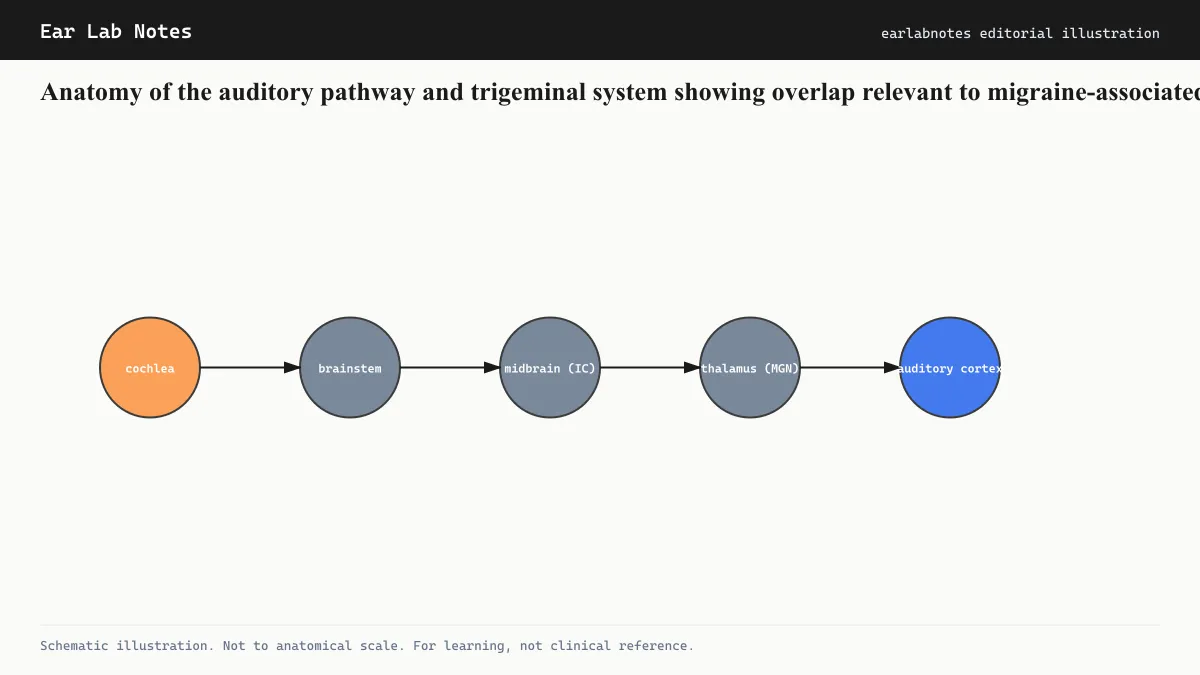
The picture that has emerged involves three overlapping mechanisms: central sensitization, cortical hyperexcitability, and the anatomical proximity of the trigeminal system to the auditory pathway.
Central sensitization
Central sensitization is a state in which the central nervous system becomes abnormally responsive to input. It is documented in migraine, in chronic tinnitus, and in several other chronic pain and sensory conditions.
In migraine, central sensitization is thought to develop through repeated episodes, making the nervous system progressively more reactive to triggers. Researchers studying tinnitus have proposed that a similar sensitization occurs in the auditory pathway, where circuits become amplified in the absence of normal cochlear input.
People who experience both conditions may have a nervous system that is generally prone to sensitization, rather than two separate diseases that happen to overlap.
Cortical spreading depression and auditory effects
During migraine with aura, a phenomenon called cortical spreading depression sweeps across the brain’s cortex. This is a slow wave of depolarization, a kind of electrical surge followed by a refractory period during which that region of cortex is suppressed.
When this wave affects the auditory cortex or adjacent areas, it can temporarily disrupt normal auditory processing. Tinnitus, muffled hearing, or heightened sound sensitivity during or around a migraine attack may reflect this transient cortical disruption rather than a change in the cochlea itself.
The tinnitus that occurs during a migraine episode is often temporary. However, for people who have both migraine and chronic tinnitus, the episode tinnitus and the baseline tinnitus are likely separate in origin.
Sound sensitivity as a shared feature
Phonophobia, an intolerance or aversion to normal sound levels, is one of the diagnostic criteria for migraine and is present in a large proportion of migraine sufferers. Hyperacusis, a related condition involving pain or discomfort at normal sound levels, also occurs at elevated rates in some tinnitus populations.
The underlying mechanism in both cases is thought to involve elevated central auditory gain: the amplification of incoming sound signals in a way that makes ordinary levels feel overwhelming. This same elevated gain is proposed as a contributor to chronic tinnitus in the central-gain hypothesis supported by NIH/NIDCD-funded researchers.
Vestibular migraine and the inner ear
Vestibular migraine is a subtype in which balance, vestibular, and inner-ear symptoms dominate. Diagnostic criteria developed by neurology and otology bodies specify that vestibular symptoms must accompany at least half of attacks and cannot be better explained by another vestibular disorder.
Tinnitus and aural fullness, the sensation of pressure or blockage in the ear, can occur during vestibular migraine episodes. This can make vestibular migraine difficult to distinguish from Meniere’s disease, since the two conditions share several features. Distinguishing them matters for management, and specialist assessment is generally required.
What the epidemiological data indicate
Studies examining the relationship between migraine and tinnitus have consistently found that migraine sufferers report tinnitus at higher rates than the general population. The strength of the association varies by study design and population, and the direction of causality remains uncertain. Population-level data reviewed by NIH researchers suggest the co-occurrence is robust enough to warrant clinical attention rather than being treated as coincidence.
Migraine-associated auditory symptoms during an attack
People who experience migraine with auditory involvement sometimes describe temporary changes in hearing during or around an attack. These can include a sensation of muffled hearing in one ear, a brief increase in tinnitus loudness, or heightened sensitivity to sound that extends beyond the migraine’s active phase.
These symptoms are transient in most cases and resolve as the migraine resolves. They are distinct from the permanent cochlear damage that produces noise-induced tinnitus. However, they are worth documenting and reporting to both a GP and an audiologist, since repeated episodes of auditory disruption warrant monitoring even when each episode resolves individually.
Aural fullness during a migraine, a sense of pressure or blockage in the ear, is particularly worth reporting to a clinician because it overlaps with the symptoms of Meniere’s disease. Distinguishing the two is important for management, and the distinction often requires specialist assessment.
Sound sensitivity across the two conditions
Both migraine and tinnitus involve a component of central sensitization that affects sound tolerance. The phonophobia of migraine and the hyperacusis that occurs in a minority of tinnitus patients share a mechanism: the central auditory gain is elevated, making ordinary sounds feel louder or more uncomfortable than they should.
People who have both conditions may find that their acoustic environment requires more careful management. Very loud environments can trigger migraine and worsen tinnitus simultaneously, while very quiet environments may make tinnitus more salient. Finding a comfortable acoustic middle ground is a practical consideration that clinicians managing either condition can discuss.
Implications for clinical assessment
When a person presents with both tinnitus and a history of migraine, several considerations are relevant:
An audiologist assessing tinnitus should be aware of the migraine history, particularly if the tinnitus fluctuates in a pattern that correlates with migraine episodes.
A neurologist managing migraine should be aware that tinnitus is present, since it may influence decisions about medication and about what symptoms to monitor.
Tinnitus that worsens significantly during migraine attacks may respond to better migraine management, though this cannot be guaranteed and should not replace dedicated tinnitus assessment.
Tinnitus that is present continuously regardless of migraine activity is more likely to require audiological management independent of migraine treatment.
Mayo Clinic and NHS UK both note that migraine is associated with a range of auditory symptoms and that specialist evaluation is appropriate when hearing or ear symptoms accompany headaches.
If symptoms persist or change, see an audiologist or physician.
Related notes
Frequently asked
Questions readers ask
- Does migraine cause tinnitus?
- Migraine is associated with higher rates of tinnitus in population studies, but the relationship is not simply causal. Shared mechanisms in the central nervous system, particularly central sensitization and cortical hyperexcitability, appear to make both conditions more likely to occur together.
- What is vestibular migraine and how does it relate to tinnitus?
- Vestibular migraine is a recognized subtype in which dizziness, vertigo, and balance disruption accompany or replace the classic headache. Tinnitus and hearing changes can occur during vestibular migraine attacks. Diagnosis is typically made by a neurologist or ENT specialist using established clinical criteria.
- Why are sounds painfully loud during a migraine?
- Phonophobia, or sensitivity to sound, is a hallmark migraine symptom recognized by neurological classification systems. Central sensitization during a migraine lowers the threshold at which the auditory system reacts to incoming sound, producing pain or distress at levels that would normally be comfortable.
- Can treating migraine improve tinnitus?
- Some people report that migraine management reduces the frequency of tinnitus episodes that occur during attacks. However, tinnitus that is present independently of migraine episodes is unlikely to respond to migraine-specific treatment. A neurologist and audiologist working together are best placed to assess this.
- What is cortical spreading depression?
- Cortical spreading depression is a wave of electrical activity followed by suppression that moves across the brain's cortex during a migraine aura. It affects sensory processing broadly and is thought to be one mechanism by which migraines can temporarily alter auditory perception, including producing tinnitus or hearing changes during an attack.
Primary sources
Where this comes from
- ◆Tinnitus: Assessment and Management · NIH/NIDCD
- ◆Tinnitus Clinical Practice Guideline · AAO-HNS
- ◆Migraine: Overview · Mayo Clinic
- ◆Tinnitus overview · NHS UK
Educational use only.
If your symptoms persist or change, see a licensed audiologist or otolaryngologist. Sudden hearing loss is a medical emergency, see a clinician within 72 hours.
TEL-N040 · The Ear Lab · earlabs.app