White noise machines are among the most widely used aids for tinnitus management. Walk into any pharmacy or read any online forum about tinnitus and you will encounter them quickly. The question worth addressing is not whether they exist, but what they actually do and what they cannot do.
The core mechanism: contrast reduction
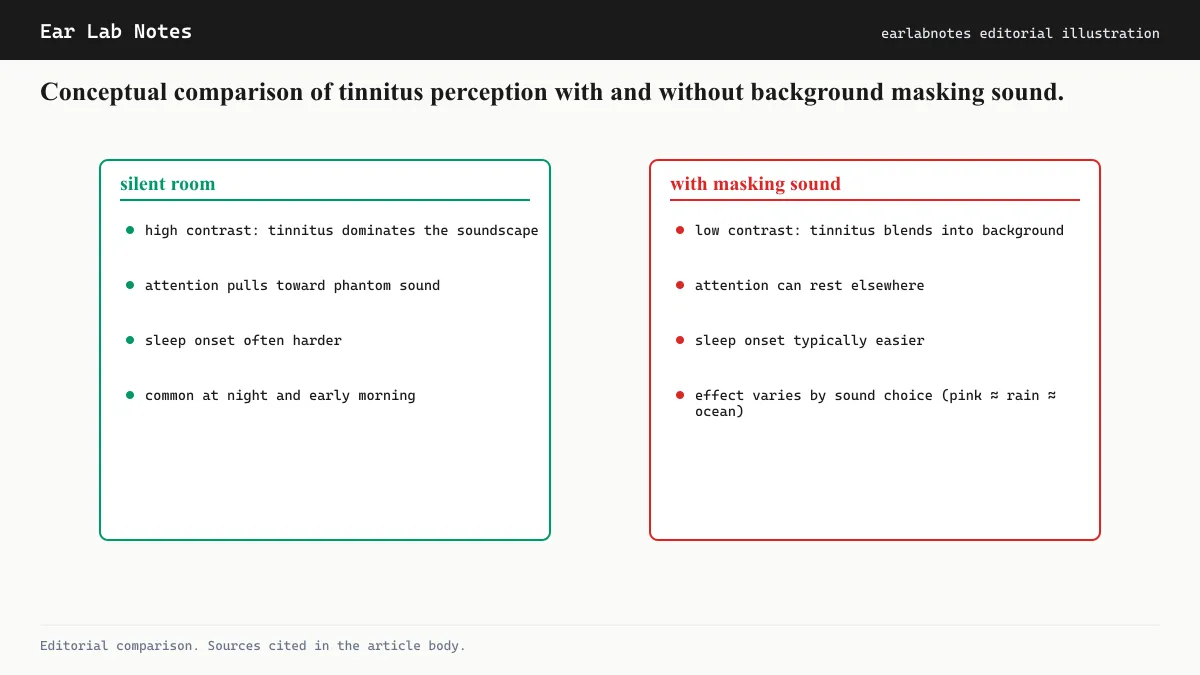
Tinnitus is a phantom sound generated by the auditory nervous system. It does not come from an external source, and that is part of what makes it so difficult to ignore. In a quiet room, the silence surrounding the phantom sound amplifies its perceived salience. The brain is wired to attend to sounds that stand out against a background, which is why tinnitus often feels most intense at night or in quiet environments.
White noise machines address this through a simple acoustic principle. By adding a consistent broadband sound to the environment, they raise the background noise floor. The tinnitus signal does not disappear, but the contrast between it and the background is reduced. The ringing that was clearly audible against silence becomes less distinct against a field of noise.
What white noise actually is
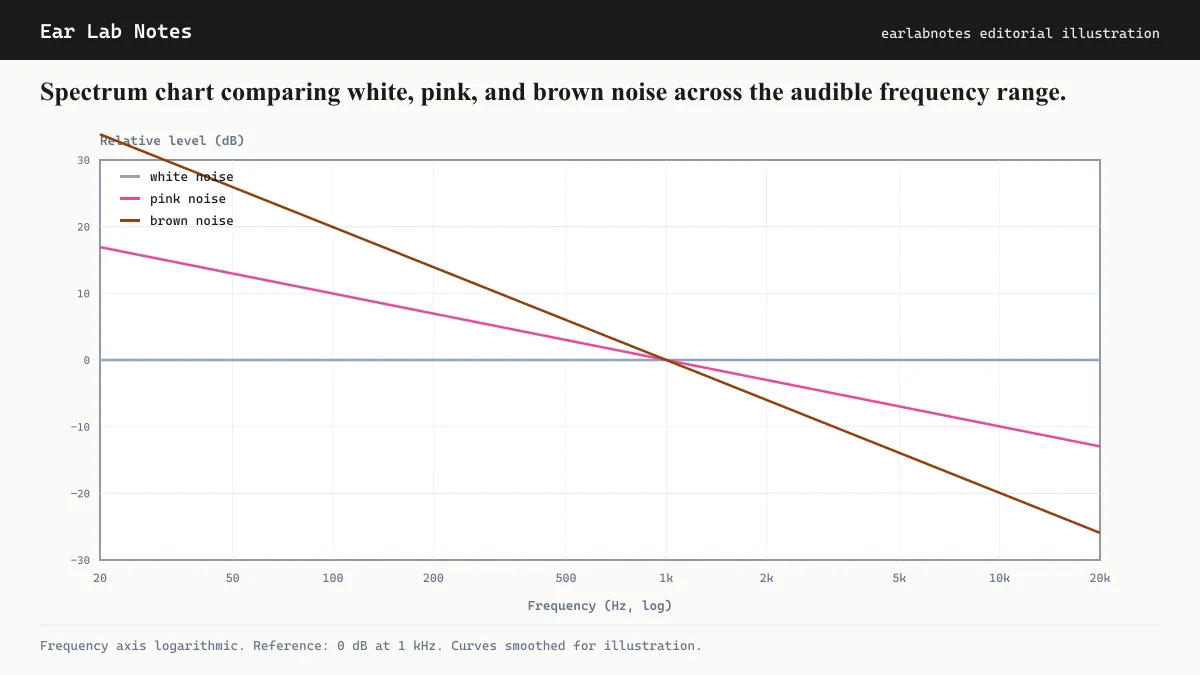
White noise contains energy at every frequency in the audible range in roughly equal amounts. It sounds like a hiss, which some people describe as similar to an untuned radio or the sound of air through a vent.
Pink noise and brown noise are related. Pink noise has the same energy per octave rather than per hertz, which means its power decreases at higher frequencies, giving it a softer, less harsh quality. Brown noise drops off even more steeply and sounds deeper and fuller.
All three are classified as broadband sounds and all three can serve a masking function. The choice between them is primarily one of comfort and preference rather than clinical evidence that one is significantly superior to the others.
What the guidelines say
The AAO-HNS clinical practice guideline on tinnitus includes sound therapy as one of the options clinicians may discuss with patients. It does not recommend any specific device or noise color, and it notes that the evidence base for masking and sound therapy is moderate rather than definitive.
The BTA acknowledges that sound enrichment (the practice of adding background sound to the environment) is widely used and reported to be helpful by many people with tinnitus, particularly for sleep and quiet situations. Their guidance frames it as a self-management strategy rather than a treatment.
The NHS similarly mentions background sound as something many people find helpful, while being clear that it does not treat the underlying condition.
Partial masking versus total masking
There is a distinction in the literature between partial masking and total masking. Total masking means the background sound is loud enough to completely cover the tinnitus. Partial masking means the sound is set just below the tinnitus level, mixing with rather than drowning out the phantom sound.
Tinnitus retraining therapy (TRT) specifically recommends partial masking on the theory that the brain needs to still detect the tinnitus in order to eventually habituate to it. Total masking may provide immediate relief but potentially delays habituation.
For casual use of white noise machines at home, this distinction is most relevant when someone is using sound therapy as part of a structured program rather than simply as a comfort measure for sleep.
Choosing a machine
A white noise machine does not require sophisticated specifications. The practical considerations are straightforward.
Volume range matters. The machine should be capable of reaching a level just above the tinnitus without maxing out. Conversely, it should not produce sound louder than about 70 dBA at typical use distance, as prolonged exposure above that level can itself be a hearing concern. NIOSH guidance on safe noise exposure is relevant here.
Sound options vary across machines. Some offer only white noise; others provide multiple options including pink noise, brown noise, and nature sounds. If one type proves uncomfortable, having alternatives is useful.
Looping artifacts can be distracting. Some machines play short audio files that loop noticeably. Continuous sound generation without obvious loops is preferable for sleep use.
Portability is worth considering if nighttime travel is common.
What to avoid
Avoid setting volume high enough to mask all environmental sounds, particularly in situations where hearing alerts or alarms is important. Do not use in-ear masking devices at high volumes for extended periods. The goal is modest contrast reduction, not maximum loudness.
The limits of white noise
White noise machines are a comfort and management tool. They do not address the neural mechanisms that generate tinnitus, they do not restore cochlear hair cells, and they do not produce lasting changes to tinnitus after they are turned off. For many people they make a genuine practical difference, especially for sleep. For others the effect is modest or the sound itself is irritating.
The NHS and BTA both frame sound enrichment as one piece of a broader approach to tinnitus management that often includes counseling and cognitive behavioral therapy when distress is significant.
If symptoms persist or change, see an audiologist or physician.
Related notes
Watch
Tinnitus UK Webinar: A Journey Through Sound
Source: Tinnitus UK (British Tinnitus Association) on YouTube
Transcript / summary
Frequently asked
Questions readers ask
- Does white noise cure tinnitus?
- No. White noise does not eliminate tinnitus or treat its underlying cause. It changes the acoustic environment to make the phantom sound less noticeable. When the machine is turned off, tinnitus remains.
- What volume should I set a white noise machine?
- Most guidance from audiologists and the BTA suggests setting the masking sound just below the level of the tinnitus, not loud enough to completely cover it. Excessively loud masking can itself cause auditory fatigue.
- Is there a difference between white noise and pink noise for tinnitus?
- Both are broadband sounds and both can reduce tinnitus contrast. Pink noise has more energy in lower frequencies and many people find it less harsh. Which works better is largely a matter of individual preference.
- Can I use a fan instead of a white noise machine?
- A fan produces a broadband sound that functions similarly to a white noise machine for masking purposes. The consistency and volume range are different, but the principle is the same.
- Should I use white noise at night specifically?
- Night is when tinnitus tends to feel most intrusive because the environment is quieter. Many people who use white noise use it primarily for sleep, which is a common application discussed in BTA guidance.
Primary sources
Where this comes from
- ◆Tinnitus · National Institute on Deafness and Other Communication Disorders (NIDCD)
- ◆Clinical Practice Guideline: Tinnitus · American Academy of Otolaryngology-Head and Neck Surgery (AAO-HNS)
- ◆Tinnitus · NHS UK
- ◆Sound Therapy for Tinnitus · British Tinnitus Association (BTA)
Educational use only.
If your symptoms persist or change, see a licensed audiologist or otolaryngologist. Sudden hearing loss is a medical emergency, see a clinician within 72 hours.
TEL-N049 · The Ear Lab · earlabs.app